
 Main Admin/Updated /2 min read/Science Explorer
Chandrayaan-3: What India Achieved on the Moon
Understand Chandrayaan-3’s landing, the roles of Vikram and Pragyan, and the surface measurements reported by ISRO.
In this article ↓
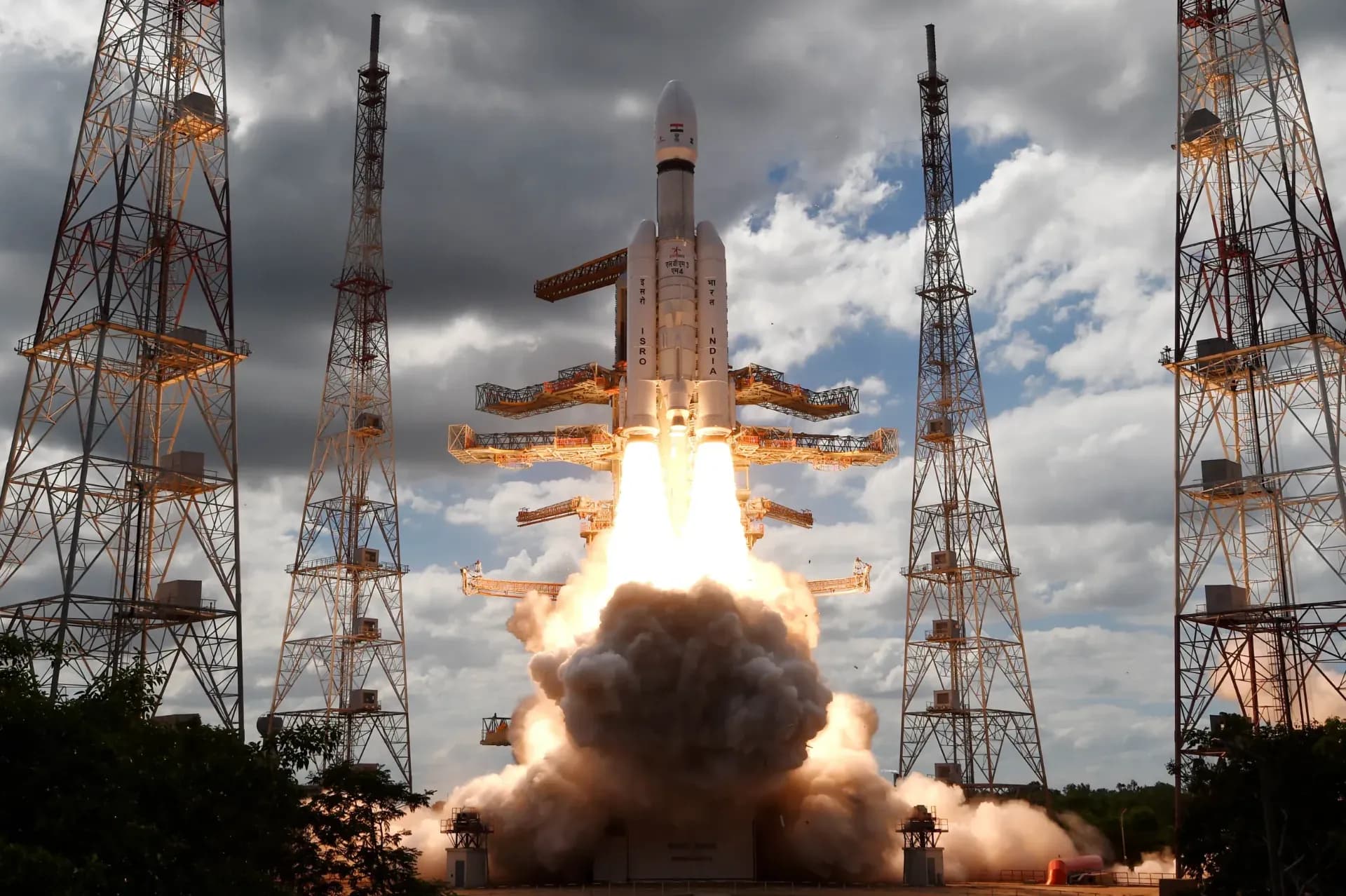
On 23 August 2023, India's Chandrayaan-3 spacecraft achieved a successful soft landing on the Moon. The achievement is best understood not as a single photograph but as the outcome of navigation, engineering and careful mission design.
What you will learn
The purpose of a soft landing, the roles of a lander and rover, and how scientific instruments add value to a mission.
A landing is a controlled descent
A spacecraft arriving near the Moon is moving quickly. A soft landing requires reducing speed, controlling orientation and identifying a safe landing region. Chandrayaan-3's Vikram lander performed the descent, while the Pragyan rover was designed to move on the lunar surface and examine its surroundings.
ISRO states three objectives for Chandrayaan-3: demonstrating a safe soft landing, demonstrating rover movement on the lunar surface, and conducting in-situ scientific experiments.
What did the instruments study?
ISRO reported measurements from instruments studying lunar surface temperature and near-surface plasma. It also reported that the rover's laser-induced breakdown spectroscopy instrument detected sulphur in surface material near the landing site. Such observations help scientists understand local lunar conditions; they do not, by themselves, prove the presence of life or accessible water reserves.
Why this matters for students
A lunar mission combines physics, mathematics, software, communication, materials science and teamwork. Students interested in space can begin with motion, gravity, programming and experimental measurement.
Exam corner
Question: What was the rover called?
A. Aryabhata B. Pragyan C. Rohini D. Bhaskara
Answer: B. Pragyan was Chandrayaan-3's rover; Vikram was the lander.
Key takeaway
Chandrayaan-3 demonstrated a successful lunar soft landing and enabled surface experiments, providing engineering experience and scientific observations.
FAQ
Was the rover a separate spacecraft launched independently? No. It travelled as part of the Chandrayaan-3 lander mission.
Source references for editorial review
Sources and editorial information
Publisher: Parasmani Pustakalaya Educational Trust. Source organizations do not endorse PPET.
Editorial review:
- ISRO Chandrayaan-3 mission updates — ISRO Chandrayaan-3 mission updatesChecked: 15 October 2026Supports: Chandrayaan-3 soft-landed on 23 August 2023.
- ISRO Chandrayaan-3 details — ISRO Chandrayaan-3 detailsChecked: 15 October 2026Supports: The mission had landing, roving and in-situ experiment objectives.
- ISRO LIBS result — ISRO LIBS resultChecked: 15 October 2026Supports: ISRO announced LIBS sulphur observations.
- ISRO/PRL APXS result — ISRO/PRL APXS resultChecked: 15 October 2026Supports: Chandrayaan-3 soft-landed on 23 August 2023.; Vikram and Pragyan were the lander and rover.
- ISRO ChaSTE temperature observations — ISRO ChaSTE temperature observationsChecked: 15 October 2026Supports: ChaSTE reported temperature-profile measurements of lunar topsoil.
- ISRO RAMBHA-LP plasma observations — ISRO RAMBHA-LP plasma observationsChecked: 15 October 2026Supports: RAMBHA-LP reported initial near-surface lunar plasma measurements.
Image credits
- Image source · ISRO · Image courtesy of ISRO · Image courtesy of ISRO · Image courtesy of ISRO
- Image source · Image courtesy of ISRO · Image courtesy of ISRO · Image courtesy of ISRO · Image courtesy of ISRO


- Science Explorer
- PPET GyanDeep
- educational learning
Keep learning within reach
Help the library grow
Your contribution supports PPET’s library and educational work. Explore how you can be part of the trust’s mission.